Carrier 178 Code (Indoor Communication Fault) in Woodland Hills
Quick read: A Carrier code 178 in Woodland Hills, CA (ZIP 91367) is an indoor communication fault: the Infinity thermostat lost its A-B-C-D link to the indoor control board. Check 1 thing, a full breaker reboot, then call Woodland Hills Carrier HVAC at (213) 513-5256 or book online and we meter the bus.
Quick details
- Code 178 = indoor-unit communication fault on a Carrier Infinity system
- The lost link is thermostat to indoor board over the A-B-C-D wiring
- Components in play: A-B-C-D wiring, indoor control board, Infinity System Control
- 178 is the indoor leg; 179 is the outdoor leg of the same bus
- Wiring repair often within one visit; a control board $400 - $2,000
- Service area 91364, 91367, 91371; independent, all brands
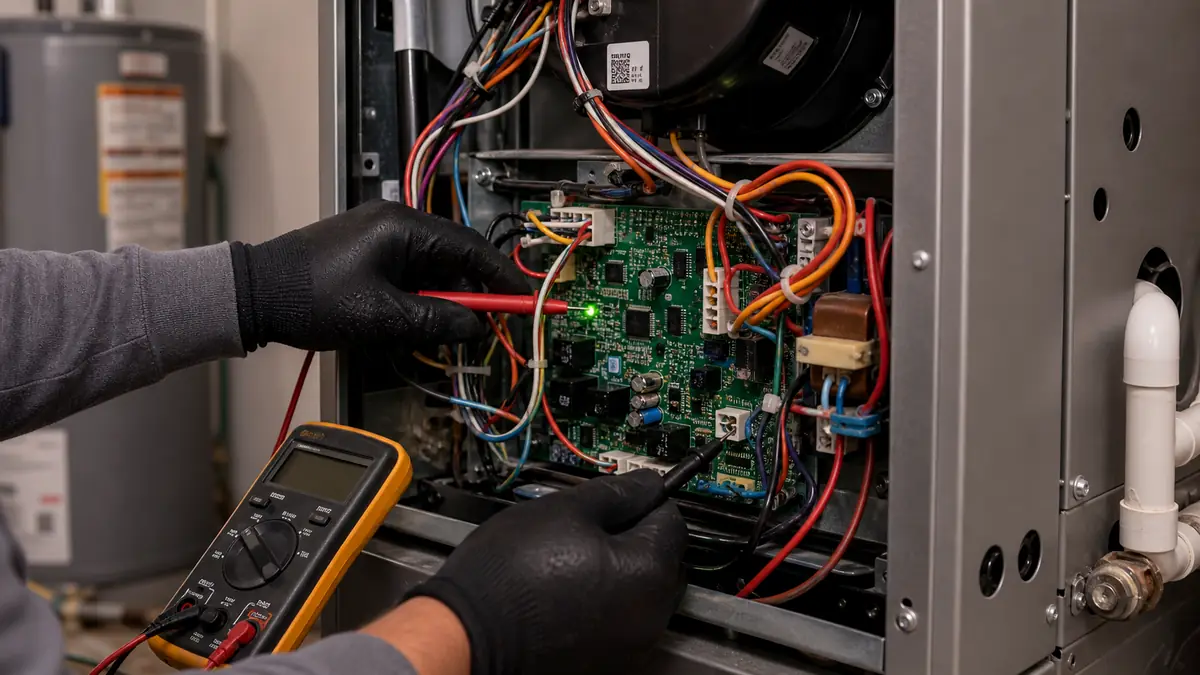
What does code 178 mean on a Carrier Infinity?
Carrier's Infinity line is a communicating system. Instead of the old thermostat that just closed a 24-volt contact, the Infinity System Control, the indoor furnace or air-handler board, and the outdoor unit all talk to each other digitally over a shared four-wire bus labeled A, B, C, and D. Two of those wires carry power and ground; the other two carry the data the components use to coordinate staging, blower speed, and inverter-compressor output. Code 178 means that conversation broke on the indoor leg: the System Control sent a message to the indoor board and got no valid reply within the timeout window, so it posts an indoor communication fault and, on most homes, the system stops conditioning because no board knows what the others want it to do.
What 178 is not matters as much as what it is. It is not a refrigerant charge problem, not a failed compressor, and not a code about heating or cooling performance. It is a data fault. The hardware that makes hot or cold air may be perfectly healthy; the boards simply cannot hear each other. That is why throwing a compressor or a capacitor at a 178 is wasted money. The fix lives in the bus and the two boards on either end of it.
Why does a Carrier 178 happen in Woodland Hills homes?
Three local patterns drive most of the 178 calls we run here. First is retrofit wiring. A lot of Walnut Acres and Carlton Terrace ranch homes had a high-efficiency Infinity system dropped onto thermostat wire that was run decades ago for a simple furnace. When an installer reuses old four-conductor cable for the A-B-C-D bus, a marginal splice or a nicked conductor in a wall can pass for years, then drop the indoor link as connections age and oxidize.
Second is heat and attic routing. Because Woodland Hills sits in that far-western Valley heat pocket where the mountains block the sea breeze, attics here run brutally hot, often 140 F-plus in summer. Communication cable baked in a 140 F attic, or stapled tight against a hot supply plenum, slowly degrades insulation and connectors until the indoor bus gets noisy enough to fault. Third is power events and water. Summer grid sag, surges, and the occasional winter rain leak into an air-handler closet in a hillside South of the Boulevard home can corrupt a board or corrode a terminal. The Vista de Oro and Warner Center luxury rebuilds tend toward the cleaner end of this, but even there a zoned Infinity install adds more boards and more bus connections, and every connector is one more place the indoor link can open.
How do you diagnose a Carrier 178, step by step?
A communication code names a broken link, not a part, so the diagnosis walks the indoor bus methodically and proves the cheap fixes before condemning a board. The number itself points us indoors, between the thermostat and the air-handler board, which already saves time.
- Full-system reboot first. We kill power to the whole system at the breakers for at least a minute, then restore it and watch the Infinity control re-establish communication. A one-time glitch clears here and never returns.
- Confirm power on the bus. At the indoor board we meter the C and D pair for the correct supply between the boards. No power means the fault is a blown low-voltage fuse or a transformer, not data.
- Inspect every A-B-C-D termination. We open the thermostat plate and the indoor board and look for loose screws, backed-out conductors, a chewed wire, attic-baked insulation, or a corroded splice, especially on retrofit cable.
- Read the data lines. With the service tool we check the A and B data pair for the proper signal and look for the noise or dropout that an aging or damaged conductor produces.
- Isolate board versus wiring. If the bus tests clean end to end but the indoor board still will not answer, the board is the suspect. We confirm by substitution or by the control's own diagnostics before quoting a board.
- Re-terminate, seal, and verify. We remake any questionable connection, restore power, confirm the fault is cleared and stays cleared through a full cycle, and clear the stored code.
What can I safely check, and what needs an Infinity tech?
There is exactly one safe homeowner step for a 178, and it is worth doing before you book: shut the whole system off at the breaker, including both the indoor and outdoor disconnects, wait a full minute, then turn it back on and let the Infinity touchscreen reboot and re-link. A transient glitch from a brownout or a momentary dropout will clear and not come back. While you wait, you can also glance at the thermostat plate to confirm it is seated tightly on its base, since a thermostat half-popped off its wall plate can open the bus.
Everything past that needs a technician. Diagnosing a 178 means metering live A-B-C-D conductors inside the air handler around energized boards, reading data signals with the Infinity service tool, and deciding board-versus-wiring without guessing, which protects you from buying a $1,500 board the system did not need. If the reboot does not hold, book a Carrier repair. If it is a triple-digit Woodland Hills afternoon and the home has someone medically vulnerable in it, treat the no-cool as urgent and use emergency service. For the matching outdoor code and other Infinity numbers, the Carrier fault-code guide lays them out.
When is a Carrier 178 code urgent?
On the comfort side, a 178 is urgent whenever it leaves a Woodland Hills home without cooling on a hot day, which here is most of the summer given 60 to 80-plus days a year at or above 90 F. Because the boards cannot coordinate, the system usually will not run at all during the fault, so a 178 in July is effectively a no-cool, and that is dangerous for older residents, infants, or anyone with a health condition in a house pushing toward 90 F indoors. That is the case to move to the front of the day.
On the equipment side, 178 carries no overheat or combustion danger the way a furnace lockout does, so there is no harm in the single breaker reboot. The thing not to do is keep power-cycling a fault that returns, hoping it stabilizes, because a bus that keeps dropping is telling you a connection or a board is degrading and will only fail harder, often at the worst moment. If the reboot does not hold the link, the right move is service, not another reset.
What does a Carrier 178 repair cost in Woodland Hills?
Cost on a 178 splits cleanly into wiring work versus a board, and the diagnosis decides which side you land on. Typical 2026 Woodland Hills ranges:
- Reboot or one-time glitch ($0, diagnostic only). If a full power cycle clears it and it stays clear, there is nothing to replace; you pay the diagnostic visit.
- A-B-C-D wiring repair (within the visit). Re-terminating a loose connector, repairing a chewed or attic-baked conductor, or sealing a corroded splice is usually completed during the same call for trip and labor.
- Indoor control board ($400 to $1,200). When the air-handler or furnace board has genuinely failed, the part plus labor lands here depending on the system.
- Infinity System Control replacement (up to about $2,000). A failed touchscreen control on a high-tier zoned Infinity system is the top of the range; we confirm the bus is clean before condemning it so you are not buying a board to fix a wire.
Common questions
What does code 178 mean on a Carrier Infinity system?
Code 178 is an indoor communication fault. The Infinity System Control thermostat stopped hearing the indoor control board over the four-wire A-B-C-D communication bus. It is a lost conversation between two boards, not a compressor or refrigerant problem, so the fix usually lives in wiring, a connector, or one of the two boards.
How is Carrier 178 different from 179?
Code 178 is the indoor link: thermostat to indoor furnace or air-handler board. Code 179 is the outdoor link: the indoor control to the outdoor unit board. Same A-B-C-D bus, different leg. Knowing which number shows tells us exactly where to start metering, indoors at the air handler versus outdoors at the condenser.
Can a homeowner fix a Carrier 178 code?
You can safely try one thing: cycle power to the whole system at the breaker for a full minute, then let the Infinity control reboot and re-link, which clears a one-time glitch. Beyond that, 178 means opening the air handler to meter the A-B-C-D bus around live boards, which is a job for a technician with the Infinity service tools.
How much does a Carrier 178 repair cost in Woodland Hills?
If the fault is a loose terminal, a chewed wire, or a corroded splice, we re-terminate and seal it within the diagnostic visit, so you pay the trip and labor only. If a board has actually failed, an indoor control board or Infinity System Control runs roughly $400 to $2,000 installed depending on which board and the system tier.