Carrier 13 Code (Limit Lockout) in Woodland Hills
Quick read: A Carrier code 13 in Woodland Hills, CA (ZIP 91364) is a limit-circuit lockout: the furnace overheated and tripped its high-limit switch about 3 times in one cycle, so it stopped firing. Replace the filter, then call Woodland Hills Carrier HVAC at (213) 513-5256 or book online and we find the airflow fault.
Quick details
- Code 13 = limit-circuit lockout from repeated high-limit trips (overheating)
- Top causes: dirty filter, closed or blocked registers, undersized return, weak blower
- Components in play: air filter, blower/ECM, high-limit switch, ductwork
- Soft lockout - one reset is safe; a repeat means the airflow fault remains
- Airflow fix about $150 - $600; high-limit switch roughly $150 - $350
- Service area 91364, 91367, 91371; independent, all brands
What does code 13 mean on a Carrier furnace?
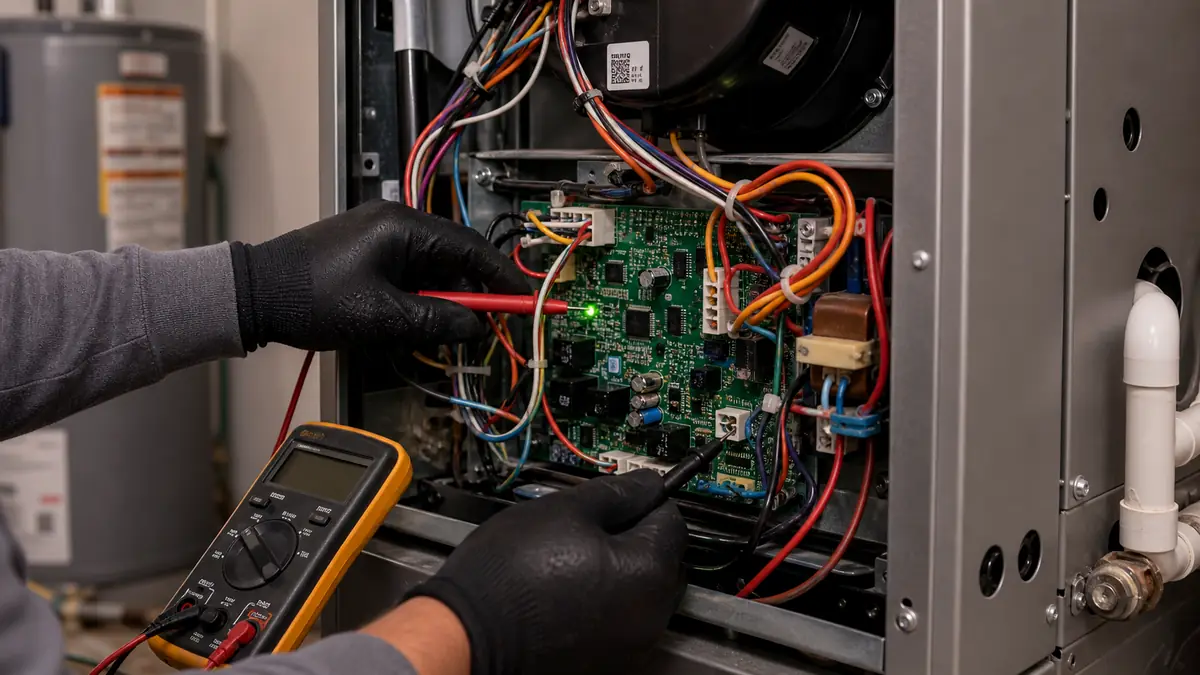
Code 13 is a limit-circuit lockout. Inside a Carrier 58- or 59-series furnace sits a high-limit switch clamped to the heat exchanger or in the supply plenum. It is a normally-closed thermal switch that opens the moment the air leaving the heat exchanger climbs past its trip point, usually around 180 to 200 F depending on the model. When it opens, the burners shut off and the blower keeps running to cool things down. If that happens three or more times inside a single heat call, the control board decides something is structurally wrong, latches a soft lockout, and flashes code 13 on the amber LED: one short flash, then three short flashes. The furnace then refuses to fire for a set period or until power is cycled. Nothing is broken in the dramatic sense. The board is simply refusing to keep cooking a heat exchanger that is running too hot.
The key word is airflow. A gas furnace is sized to dump a fixed amount of heat into a moving river of air. If that river slows down, the same flame heats less air to a higher temperature, the limit switch sees the spike, and you get code 13. Roughly nine times out of ten the switch itself is fine and is doing exactly its job; the fault is upstream, in whatever is choking the air moving across the heat exchanger.
Why does my Carrier furnace trip code 13 in Woodland Hills?
Woodland Hills furnaces hit code 13 for reasons baked into the housing. The mid-century ranch and split-level stock across Walnut Acres and Carlton Terrace was built with undersized, long return-duct runs and a single central return grille. Those returns were marginal when the home had a 1965 furnace moving less air; drop in a modern 80,000 BTU replacement and the return cannot feed it, so static pressure climbs and the limit trips. The hillside contemporary estates South of the Boulevard add a second pattern: long, snaking supply trunks up split levels, often with several registers homeowners close in unused rooms, which strangles airflow the furnace was sized to deliver.
Then there is the local heat-pocket effect. Because the Santa Monica Mountains block the sea breeze, Woodland Hills runs hot and dusty, so filters load up fast and many owners run a thick, high-MERV filter to fight Valley dust and wildfire smoke. A clogged or over-restrictive filter is the single most common code 13 trigger we pull from these homes. Newer luxury rebuilds in Vista de Oro and Warner Center are not immune either: a fresh furnace mated to original ductwork, or a closed zone damper on an Infinity zoned system, drops airflow below what the burner needs and trips the same lockout.
How do you diagnose a Carrier code 13, step by step?
A limit lockout is an airflow puzzle, so the diagnosis measures air, not guesses at parts. Replacing the high-limit switch first is the classic mistake; it almost never fixes a 13. Here is the order we work:
- Confirm the code and the flash pattern. One short flash plus three short flashes on the control LED is code 13. We photograph it and pull any stored history on Infinity systems.
- Inspect the filter and returns. A loaded filter, a partially closed return, or a return grille blocked by furniture is found and corrected before anything else.
- Measure temperature rise. We probe supply and return plenum temperatures; the reading must land inside the rating-plate rise band, often 35 to 65 F. A rise above the top of that band confirms low airflow is overheating the exchanger.
- Read total external static pressure. A manometer across the air handler tells the truth. Anything past about 0.8 in. w.c. on a system rated for 0.5 means the ducts, coil, or filter are choking it.
- Check the blower and ECM. We verify the blower wheel is clean, the motor reaches commanded RPM, and the speed tap or ECM airflow setting matches the furnace size.
- Test the limit switch only after airflow checks out. If air is good but the switch opens at far below its rated temperature, then and only then is the switch itself the failed part.
What can I safely check before calling a pro?
Plenty of code 13 calls end at the filter, and those are safe homeowner checks. Turn the thermostat to off, then swap in a clean filter of the correct size; if you have been running a 1-inch MERV 13, try a MERV 8 to MERV 11 and see if the lockout clears. Walk the house and open every supply register and return grille, including ones in spare bedrooms, and pull furniture or rugs off any return. Cycle power at the furnace switch or breaker for 30 seconds to clear the soft lockout, then start a heat call and watch.
Stop there. Opening the blower compartment, metering the high-limit switch, pulling the gas manifold, or inspecting the heat exchanger is pro territory: it involves line voltage, the gas train, and a combustion component where a misread crack is a carbon-monoxide risk. If code 13 returns after one reset and a fresh filter, the airflow restriction is somewhere you cannot safely reach, and it is time to book a Carrier repair. The broader Carrier fault-code guide covers the neighboring lockout codes 14, 31, and 34 if your screen shows a different number.
When is a Carrier 13 code urgent?
Code 13 itself is not an emergency the way a gas smell or a rollout trip is, because the furnace has already shut its own burners off. The urgency is about the cold and about not making it worse. On the handful of genuinely cold Woodland Hills mornings, a locked-out furnace means no heat, which matters most for older residents, infants, or anyone medically vulnerable; that is a reason to move it to the front of the schedule. The deeper risk is cumulative: every time the heat exchanger overheats and you reset without fixing airflow, you shorten its life and inch toward a crack. A cracked heat exchanger is a safety condemnation and a carbon-monoxide concern, and it turns a cheap airflow repair into a furnace replacement.
The practical rule: reset code 13 once after a fresh filter. If it comes right back, do not keep resetting it. Stop, and book service. If anyone in the home is medically vulnerable and it is cold, treat it as same-day and use emergency service.
What does it cost to fix a Carrier 13 code in Woodland Hills?
The bill follows the airflow fault the lockout is pointing at, not the code itself. Typical 2026 Woodland Hills ranges:
- Filter and register correction ($0 to $150). The cheapest and most common outcome: a fresh, correctly-rated filter and opened returns clear the lockout, often inside the diagnostic visit.
- Airflow or duct repair ($150 to $600). Cleaning a clogged blower wheel, correcting an ECM airflow setting, opening a crushed return, or adding return capacity to an undersized mid-century duct system sits here.
- High-limit switch replacement ($150 to $350). When the switch genuinely fails or trips low, it is an inexpensive part plus labor; we only replace it after airflow tests confirm the switch, not the air, is the problem.
- Heat exchanger or furnace replacement (diagnose first). If chronic overheating has cracked the exchanger, replacement economics usually favor a new high-efficiency furnace, which is also the moment to right-size the return ducts so the new unit never trips a 13.
Common questions
What does code 13 mean on a Carrier furnace?
Code 13 is a limit-circuit lockout. The high-limit switch opened repeatedly because the heat exchanger ran too hot, usually from low airflow, so after several trips in one cycle the control board locks the furnace out and stops firing to protect the heat exchanger from overheat damage.
Can I reset a Carrier 13 lockout myself?
Yes, you can clear it once by switching the furnace off at the wall switch or breaker for 30 seconds, replacing a dirty filter, and opening every supply and return register first. If code 13 returns within a cycle or two, the airflow problem is still there and the unit needs a technician with a manometer.
Is a Carrier 13 code dangerous?
Not immediately, because the lockout is the safety working as designed: it shuts the burners down before the heat exchanger overheats. The danger is repeatedly resetting it without fixing the airflow, since chronic overheating can crack a heat exchanger over time and turn a $20 filter problem into a furnace replacement.
How much does it cost to fix a Carrier 13 code in Woodland Hills?
An airflow fix runs about $150 to $600 in Woodland Hills, covering filters, a duct or return correction, or a blower cleaning. A failed high-limit switch is roughly $150 to $350 installed. We confirm the real cause with a temperature-rise and static-pressure reading before quoting, so you only pay for the part that actually tripped.