Carrier AC Not Cooling in Woodland Hills
Quick read: A Carrier AC running but not cooling in Woodland Hills usually traces to a failed capacitor, low refrigerant, an iced coil, or an Infinity code 44 airflow restriction, so call Woodland Hills Carrier HVAC at (213) 513-5256 or book online across 91364 for a same-week, roughly $139 diagnostic. We cover Walnut Acres to Valley Circle.
Quick details
- Top causes: capacitor/contactor, low refrigerant, dirty/iced coil, weak blower
- Infinity code 44 flags an air-delivery restriction
- Capacitor / contactor: $150 - $450, often same visit
- Refrigerant leak + recharge: $225 - $1,500
- ECM blower motor: $450 - $2,300
- Diagnostic commonly around $139; service area 91364, 91367, 91371
- Independent, all brands; open daily 7am-9pm
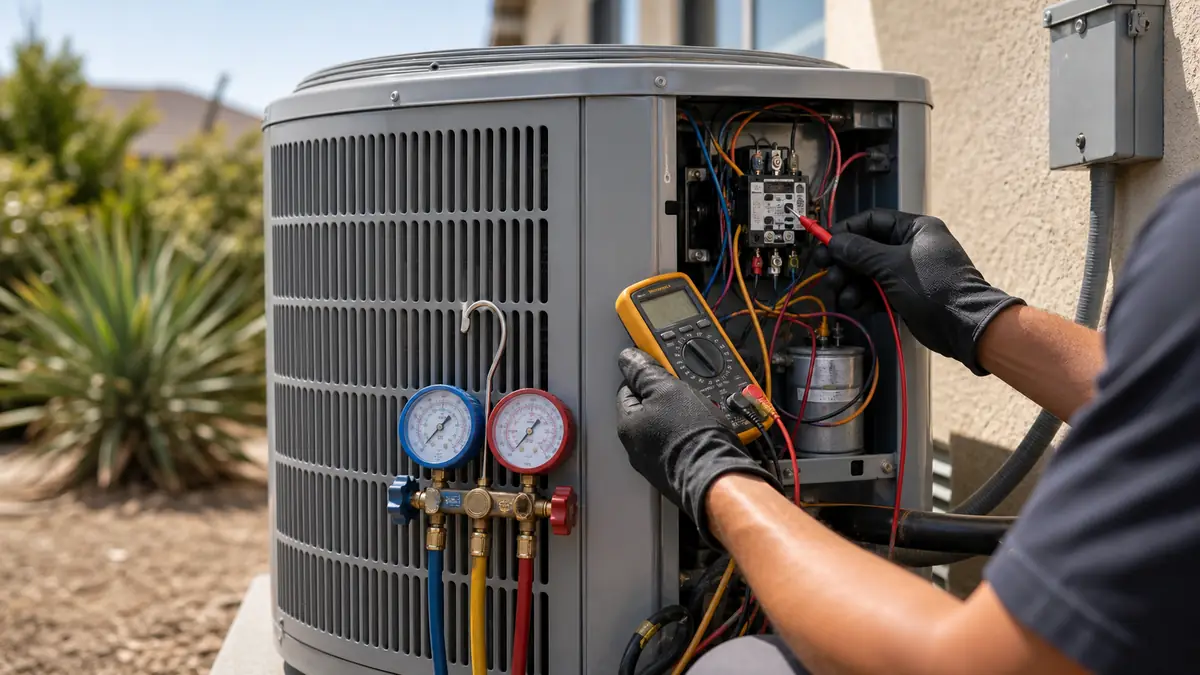
Is the outdoor unit even running?
This is the first thing to check on a no-cool call. Walk to the condenser. If the fan and compressor are spinning, the system is trying to cool and the problem is likely refrigerant, airflow, or a frozen coil. If the outdoor unit is silent or just humming on a 100 F Vista de Oro afternoon, you almost certainly have a failed dual-run capacitor or a pitted contactor, both same-visit fixes.
What are the most likely causes?
| What you see | Likely cause / first check | Cost lane |
|---|---|---|
| Indoor fan runs, outdoor unit silent | Capacitor or contactor | $150 - $450 |
| Cools weakly, coil iced over | Low refrigerant or airflow restriction | $225 - $1,500 |
| Long run times, never reaches setpoint | Dirty coil/filter; Infinity code 44 | $150 - $600 |
| Weak airflow at the vents | ECM blower module or motor | $450 - $2,300 |
| Outdoor unit trips breaker on start | Failing compressor or shorted fan motor | $1,200 - $3,500 |
Why do Woodland Hills systems lose cooling capacity?
With 60 to 80-plus days a year over 90 F and 140 F attics, west-Valley condensers run at high head pressure for hours. That heat cooks marginal capacitors and pushes a slowly leaking coil over the edge: the charge that was barely adequate in spring is not enough on a 104 F day. Undersized 1960s return ducts on the older tracts starve the coil for airflow, which both ices the coil and triggers a code 44 on Infinity systems.
How does a tech diagnose a no-cool call, step by step?
Order matters, because the wrong sequence leads to the classic mistakes: dumping refrigerant into an airflow problem, or condemning a compressor that only had a $25 capacitor. A disciplined no-cool diagnosis on a Carrier system runs roughly like this.
- Read the thermostat or Infinity touchscreen. A stored 44 (airflow), 54 or 56 (sensor), 73 (voltage at the run cap with no compressor call), or 178/179 (communication) narrows the field before any panel comes off.
- Confirm the call reaches the condenser. We verify 24 volts on the Y circuit at the outdoor unit; if it is missing, the trouble is upstream at the thermostat, a tripped float switch, or the low-voltage wiring, not the compressor.
- Meter the easy electrical failures. At the condenser we read dual-run capacitor microfarads against the nameplate, test contactor pull-in, and clamp condenser-fan and compressor amps against the rated-load (RLA) figure.
- Gauge the refrigerant circuit only if needed. If electrical tests pass but cooling is weak, we read superheat and subcooling to separate a real leak from a restriction, and check static pressure at the air handler.
- Verify the fix. After the repair we recheck amp draw and the temperature split across the coil, typically 16 to 22 F on a healthy system, and clear any stored code so the next fault is genuinely new.
What can I safely try before calling, and what needs a pro?
A few checks are squarely homeowner territory and fix a real share of no-cool calls. Replace a dirty filter, set the system to fan-only for an hour to thaw an iced coil, rinse leaves and dust off the outdoor condenser with a gentle hose, and confirm the breaker and the outdoor disconnect are both on. Anything past that, metering a capacitor, opening the refrigerant circuit, or testing the compressor windings, needs tools and EPA refrigerant handling, and running a system that is low on charge or airflow can damage the compressor. If it still will not cool, stop and book a Carrier AC repair; if someone vulnerable is in a hot home on a triple-digit day, use emergency service. The fault-code guide decodes any number on the screen.
What does it cost to fix a Carrier AC that is not cooling?
The bill tracks the part that failed, not the symptom. Here is how the common no-cool causes price out in 2026 Los Angeles ranges:
- Capacitor or contactor ($150-$450). The most common SoCal failure and almost always a same-visit fix; the part is cheap and most of the cost is the trip and labor.
- Refrigerant leak repair and recharge ($225-$1,500). A leak search runs roughly $100 to $330, and R-410A is about $50 to $80 per pound installed, so a small flare leak lands low while a major coil leak lands high.
- Dirty-coil or airflow service ($150-$600). Clearing a code 44 restriction by cleaning a coil, fixing a return, or replacing a starved filter sits in the lower service range.
- ECM blower motor ($450-$2,300). A simple PSC motor is low; a variable-speed ECM module and motor on an Infinity air handler is at the top.
- Compressor ($1,200-$3,500). Greenspeed inverter compressors sit at the high end; if the unit is still inside Carrier's warranty you may pay labor only, which is the moment an authorized dealer is the right first call.
Common questions
Why is my Carrier AC running but blowing warm air?
If the indoor fan blows but the air is not cold, the outdoor condenser may not be running because of a failed capacitor or contactor, or the system may be low on refrigerant from a leak. Check whether the outdoor unit is spinning; a quiet condenser on a hot day usually means an electrical part, not the compressor.
Why does my Carrier AC freeze up and stop cooling?
An iced evaporator coil comes from restricted airflow, a dirty filter or coil, a weak blower, or low refrigerant. The ice insulates the coil so it stops absorbing heat. Turn the system to fan-only for an hour to thaw it, replace the filter, and if it ices again you likely have a charge or airflow problem we need to measure.
How fast can you fix a no-cool Carrier AC in Woodland Hills?
Electrical failures like a capacitor or contactor are usually same-visit since we stock those parts. Refrigerant leaks need a leak search and recharge, and a compressor or board may need an ordered part. On a heat-risk day we triage urgent calls to the front.
Is a warm-blowing Carrier AC low on refrigerant or is it the compressor?
Both look similar from the vent, but they read differently at the unit. Low refrigerant from a leak shows up as a higher-than-spec superheat on the gauges and often a partly iced coil, while a dead compressor usually leaves the outdoor fan running with no hum from the compressor or trips the breaker on start. We confirm with gauges and an amp clamp rather than guessing, because adding refrigerant to a failing compressor wastes money.
Why does my Carrier AC cool fine at night but not in the afternoon heat?
A system that is marginal on charge or airflow can just barely keep up at a 75 F night but fall behind once it is 104 F outside and the attic is 140 F. The condenser runs at much higher head pressure in peak heat, so a weak capacitor, a dirty coil, or a slightly low charge that hid all spring finally shows as warm air on the worst Woodland Hills afternoons. That afternoon-only pattern is a strong hint to measure charge and amp draw under load.